
Retatrutide vs Tirzepatide: Triple vs Dual Agonist Compared (UK 2026)
How Eli Lilly’s investigational triple-hormone agonist stacks up against Mounjaro’s dual-agonist mechanism — trial data, side effects, and UK availability compared.
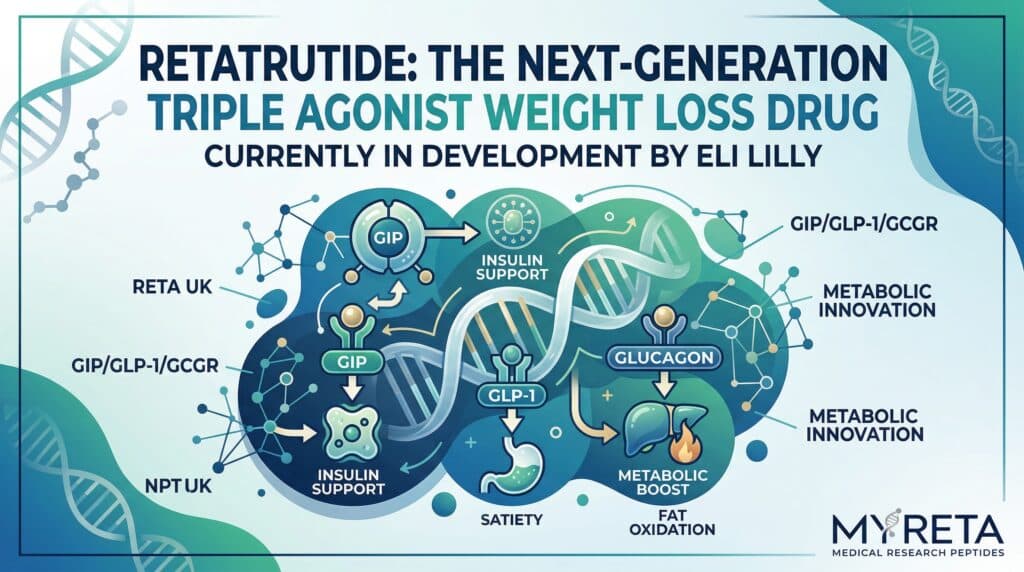
The short answer: tirzepatide (Mounjaro) activates two hormone receptors — GLP-1 and GIP. Retatrutide, still investigational, adds a third: glucagon. In Phase 3 trials, that third receptor is linked to retatrutide’s larger weight-loss figures (up to 28.7% vs tirzepatide’s roughly 20–22.5%) and a markedly bigger effect on liver fat. Retatrutide is not yet approved anywhere and is not a like-for-like substitute for tirzepatide, which is licensed and NICE-recommended in the UK today.
The pharmacological landscape for the treatment of obesity and type 2 diabetes in the United Kingdom is currently witnessing a transformative shift, moving from single-hormone mimics to sophisticated multi-receptor poly-agonists. Retatrutide (LY3437943), an investigational synthetic peptide developed by Eli Lilly and Company, represents the vanguard of this third-generation metabolic therapy. As the UK healthcare system grapples with the escalating socio-economic burden of obesity — costing the National Health Service billions of pounds each year — the emergence of retatrutide offers a clinical efficacy profile that rivals bariatric surgery, potentially redefining the standards of care for chronic weight management. For the full molecular breakdown of the compound itself, see our Retatrutide (LY3437943) research compound profile.
Retatrutide vs Tirzepatide vs Semaglutide: The Comparison Table
For UK clinicians and researchers, the choice between semaglutide, tirzepatide, and the still-investigational retatrutide comes down to a balance of receptor targets, trial efficacy, tolerability, and what’s actually licensed today.
| Feature | Semaglutide (Wegovy) | Tirzepatide (Mounjaro) | Retatrutide (Investigational) |
|---|---|---|---|
| Receptor Targets | GLP-1 | GLP-1, GIP | GLP-1, GIP, Glucagon |
| Agonist Class | Single (mono) | Dual | Triple |
| Max Trial Weight Loss | ~15% (68 weeks) | ~22.5% (72 weeks) | ~28.7% (68 weeks) |
| HbA1c Reduction | 1.0–1.5% | 1.6–2.4% | 1.3–2.0% |
| Liver Fat Reduction | Modest | Moderate | Up to 86% |
| Common Side Effects | GI (Nausea, Vomiting) | GI (Nausea, Vomiting) | GI + Dysesthesia |
| UK Availability | Available | Available | Investigational only |
While tirzepatide established superiority over semaglutide in the SURMOUNT-5 trial—achieving 20.2% weight loss vs 13.7%—indirect network meta-analyses suggest that retatrutide will likely surpass tirzepatide in both absolute and percentage weight reduction. One such meta-analysis reported an absolute weight reduction difference of approximately 4.5 kg in favor of retatrutide over tirzepatide. For the published Phase 3 figures behind retatrutide’s side of this table, see our TRIUMPH Phase 3 results breakdown.
Why a Third Receptor Matters: Dual vs Triple Agonism
To understand why the third receptor moves the numbers this much, it helps to trace the trajectory of incretin mimetics. The first generation of these therapies focused on GLP-1 receptor agonism alone. Semaglutide, marketed as Wegovy for weight management and Ozempic for type 2 diabetes, demonstrated that targeting the GLP-1 receptor could achieve an average weight loss of approximately 15% over 68 weeks. The second generation, exemplified by tirzepatide (Mounjaro), introduced dual agonism. By combining GLP-1 and GIP receptor activation, tirzepatide leveraged synergistic pathways to push efficacy boundaries toward 22.5% weight loss in primary clinical trials. Tirzepatide’s approval by the Medicines and Healthcare products Regulatory Agency (MHRA) and its subsequent recommendation by the National Institute for Health and Care Excellence (NICE) established a benchmark for potency in the UK market. Retatrutide represents the third generation: a triple agonist that adds a third hormonal pathway—glucagon—to the GLP-1 and GIP foundation. The addition of the glucagon receptor is particularly significant, as it addresses energy expenditure and hepatic lipid metabolism in ways that GLP-1 and GIP agonists cannot achieve in isolation.
GLP-1 Receptor Activation: Appetite and Glycemia (shared by all three)
The GLP-1 component of retatrutide functions similarly to established agonists like semaglutide and tirzepatide. Upon binding to the GLP-1 receptor (GLP-1R) in the pancreas, it stimulates glucose-dependent insulin secretion and inhibits glucagon release during hyperglycemic states. In the central nervous system, particularly the hypothalamus and the area postrema, GLP-1R activation suppresses appetite and enhances satiety. Furthermore, it slows gastric emptying, which reduces postprandial glucose excursions—a critical factor for the millions of people in the UK living with type 2 diabetes.
GIP Receptor Activation: The Second Receptor (shared with tirzepatide)
GIP receptor (GIPR) agonism is the primary driver of tirzepatide’s and retatrutide’s potent effect on lipid metabolism and glucose control beyond semaglutide alone. While GLP-1 focuses on reducing intake, GIP improves the body’s ability to handle energy. It facilitates insulin secretion and plays an essential role in adipose tissue buffering, which may help prevent ectopic fat deposition in the liver and muscles. The synergistic relationship between GLP-1 and GIP appears to enhance satiety and energy balance more effectively than either hormone alone, as evidenced by the superior results of tirzepatide over semaglutide in the SURMOUNT-5 head-to-head trials.
Glucagon Receptor Activation: Retatrutide’s Third Receptor
The addition of glucagon receptor (GCGR) agonism is what sets retatrutide apart from tirzepatide and every other currently approved therapy in the UK. Traditionally, glucagon was viewed as a hormone that raises blood glucose; however, recent research has highlighted its role in promoting energy expenditure and fat oxidation. By activating GCGR in the liver, retatrutide increases thermogenesis and lipolysis. This mechanism effectively instructs the liver to burn its fat stores for energy, leading to the profound reductions in hepatic steatosis observed in clinical trials — a Phase 2 MASLD/MASH substudy recorded average liver fat reductions of up to 86% at the 12 mg dose, far beyond what dual- or single-agonist therapies achieve. Any potential hyperglycemic effects of glucagon are neutralized by the potent insulinotropic actions of the GIP and GLP-1 components, resulting in a net metabolic gain without compromising glycemic stability.
Clinical Evidence: The TRIUMPH Programme
The clinical development of retatrutide is being tracked through the TRIUMPH programme, a series of global Phase 3 trials designed to secure regulatory approval across multiple indications, including chronic weight management, type 2 diabetes, and related comorbidities. For the full results write-up, see our dedicated Retatrutide TRIUMPH Results guide.
Phase 2 Benchmarks: Setting the Stage
Phase 2 results published in the New England Journal of Medicine and The Lancet provided the first robust evidence of retatrutide’s potential relative to dual-agonist therapy. In a 48-week trial of 338 adults with obesity, participants randomized to the 12 mg dose achieved a mean weight loss of 24.2%, which equated to approximately 26.2 kg for a person at a high starting weight.
| Dose (Weekly) | Mean Weight Loss (48 Weeks) | Participants Achieving ≥5% Loss | Participants Achieving ≥15% Loss |
|---|---|---|---|
| Placebo | -2.1% | – | – |
| 1 mg | -8.7% | – | – |
| 4 mg | -17.1% | 92% | 60% |
| 8 mg | -22.8% | 100% | 75% |
| 12 mg | -24.2% | 100% | 83% |
Data derived from Phase 2 obesity trials. Importantly, the weight loss curves in these trials had not plateaued at the 48-week mark, suggesting that longer-term treatment could yield even more significant results. This observation laid the groundwork for the 68-week and 80-week TRIUMPH Phase 3 trials.
TRIUMPH-4: Breakthrough in Osteoarthritis and Extreme Weight Loss
In December 2025, the results of the TRIUMPH-4 trial (NCT05869903) were released, marking the first successful Phase 3 readout for retatrutide. This trial specifically evaluated retatrutide in adults with obesity or overweight and concomitant knee osteoarthritis. The 12 mg dose achieved an average weight loss of 28.7% over 68 weeks—a figure that exceeds tirzepatide’s own Phase 3 obesity results. The impact on osteoarthritis was equally significant. Participants reported a 75.8% reduction in pain on the Western Ontario and McMaster Universities Osteoarthritis Index (WOMAC) scale. Approximately 12.0% of participants on the highest dose became completely pain-free, demonstrating how extreme weight loss can radically alter the clinical course of degenerative joint disease.
TRIUMPH-1 and Core Obesity Management
The TRIUMPH-1 trial (NCT05929066) investigated retatrutide in the broader population of adults with obesity or overweight without diabetes. This trial, which includes several UK-based sites, measures not only weight change but also improvements in blood pressure, fasting insulin, and waist circumference against the same benchmarks used in tirzepatide’s own SURMOUNT programme.
Safety, Tolerability, and Unique Side Effects
The potent metabolic intervention of retatrutide comes with a predictable but significant side effect profile, and the comparison with tirzepatide isn’t purely about efficacy — tolerability matters for anyone weighing the two mechanisms.
Gastrointestinal Effects
Like tirzepatide and semaglutide, retatrutide’s most common adverse events are gastrointestinal (GI). In the Phase 3 TRIUMPH-4 trial, nausea was reported by 43%, diarrhea by 33%, and vomiting by 21% of participants—broadly comparable to tirzepatide’s own GI profile. These symptoms are most prevalent during the dose-escalation phase and are generally mild to moderate.
The Dysesthesia Signal — Not Seen with Tirzepatide
A safety signal specific to retatrutide, and not a feature of tirzepatide’s dual-agonist profile, is dysesthesia—an abnormal or unpleasant skin sensation such as tingling, burning, or increased sensitivity. This affected 20.9% of participants on the 12 mg dose in Phase 3 trials, compared to less than 1% in the placebo group. While rarely severe enough to cause discontinuation, it is a hallmark of the triple agonist mechanism, likely linked to glucagon’s influence on sensory pathways or metabolic shifts in the peripheral nervous system.
| Adverse Event | 9 mg Frequency | 12 mg Frequency | Placebo Frequency |
|---|---|---|---|
| Nausea | – | 43% | – |
| Diarrhea | – | 33% | – |
| Vomiting | – | 21% | – |
| Dysesthesia | 8.8% | 20.9% | 0.7% |
| Discontinuation (AEs) | 12.2% | 18.2% | 4.0% |
Compilation of adverse event data from TRIUMPH-4 and Phase 2 trials. Due to the glucagon component, some participants also experienced a transient increase in heart rate during the first few months of treatment, requiring careful monitoring in patients with pre-existing arrhythmia or cardiovascular disease — a consideration that doesn’t apply to GLP-1/GIP dual agonism in the same way.
The UK Regulatory and Access Landscape
Unlike tirzepatide, which is MHRA-approved and NICE-recommended today, retatrutide must still navigate a complex multi-stage approval and commissioning process before it reaches UK patients as a licensed medicine.
Phase 3 Progress and Trial Sites in the UK
The UK is playing a central role in the TRIUMPH programme, with several academic centers and primary care research sites actively participating in the trials, including Heartlands Hospital (Birmingham), Aintree University Hospital (Liverpool), Leicester General Hospital, and Glasgow Royal Infirmary, alongside primary care sites such as Layton Medical Centre (Blackpool) and Rowden Surgery (Chippenham).
MHRA Licensing and the ILAP Route
Eli Lilly is expected to submit retatrutide to the MHRA for marketing authorization in late 2026 or early 2027. The drug may be eligible for the Innovative Licensing and Access Pathway (ILAP), which aims to accelerate the time to market for medicines that address significant public health needs. Once licensed, retatrutide will likely become available first through private prescriptions, following the same path tirzepatide took before its NICE recommendation.
NICE Technology Appraisal and NHS Rollout
The National Institute for Health and Care Excellence (NICE) will conduct a technology appraisal to assess the cost-effectiveness of retatrutide against tirzepatide and semaglutide. If the precedent of tirzepatide is followed, NICE will likely recommend retatrutide for patients with a high BMI and at least one weight-related comorbidity, phased in over several years to manage the logistical and financial strain on the NHS — prioritising, as tirzepatide’s own rollout did, patients with a very high BMI and four or more qualifying comorbidities (hypertension, dyslipidaemia, OSA, cardiovascular disease, or type 2 diabetes) first, before extending to patients with a BMI of 35–39.9 and multiple comorbidities.
Maintenance, Long-Term Success, and Wraparound Care
Prominent UK obesity specialists have emphasized that while these drugs — tirzepatide and, prospectively, retatrutide alike — are significant clinical tools, they are not quick fixes. The chronic nature of obesity means that medication cessation often leads to rapid weight regain. A systematic review found that weight regain after stopping GLP-1 and dual-agonist drugs was faster than after ending behavioural weight-loss programmes, occurring at a rate of approximately 0.3 kg per month. This suggests that retatrutide, despite its potency, will likely require the same long-term maintenance strategy tirzepatide already demands—potentially involving lower “maintenance” doses once weight loss targets are achieved, alongside nutritional counselling, psychosocial support, and resistance exercise to preserve lean muscle mass.
Frequently Asked Questions
Is retatrutide better than tirzepatide?
In separate Phase 3 trials, retatrutide’s 12 mg dose produced greater mean weight loss (up to 28.7%) than tirzepatide’s own trials (roughly 20–22.5%), and a much larger reduction in liver fat. These are indirect comparisons from different trials, not a head-to-head study, and retatrutide is not yet approved for use anywhere — so “better” currently means better trial data, not an available alternative.
What is the difference between a dual and triple agonist?
A dual agonist like tirzepatide activates two hormone receptors (GLP-1 and GIP). A triple agonist like retatrutide activates those same two plus a third, the glucagon receptor, which is linked to greater energy expenditure and fat breakdown — particularly in the liver.
Is retatrutide the same as Mounjaro?
No. Mounjaro is the brand name for tirzepatide, a dual GLP-1/GIP agonist that is MHRA-approved and NICE-recommended. Retatrutide is a separate, investigational triple agonist compound with no marketing authorisation anywhere.
When will retatrutide be available in the UK?
Eli Lilly is expected to submit retatrutide for MHRA marketing authorisation in late 2026 or early 2027, with a realistic approval window of late 2027 to mid-2028 under standard review timelines. NHS availability, if NICE recommends it, would follow years after that. Until then, it remains available only as a research compound.
Does retatrutide cause more side effects than tirzepatide?
The gastrointestinal side effect profile (nausea, diarrhoea, vomiting) is broadly similar to tirzepatide. Retatrutide does carry one side effect not associated with tirzepatide’s dual-agonist mechanism: dysesthesia (an unusual skin tingling or burning sensation), reported in around 21% of participants on the 12 mg dose in Phase 3 trials.
Why does retatrutide reduce liver fat more than tirzepatide?
The extra effect comes from the glucagon receptor, which tirzepatide doesn’t target. Glucagon signalling in the liver increases fat breakdown (lipolysis) and energy expenditure directly, on top of the appetite and insulin effects shared with GLP-1/GIP dual agonism — which is why Phase 2 data showed liver fat reductions of up to 86% at the 12 mg dose.
Conclusion: Triple Agonism as the Next Step Beyond Tirzepatide
Retatrutide represents the logical next step after tirzepatide’s dual-agonist benchmark: the same GLP-1 and GIP foundation, with a third receptor, glucagon, added on top. In trial data so far, that third receptor is linked to larger weight-loss figures and a markedly bigger effect on liver fat than either tirzepatide or semaglutide have shown. It is not, however, a drop-in replacement available today — tirzepatide is the licensed, NICE-recommended option in the UK right now, while retatrutide remains investigational, working through Phase 3 and toward an MHRA filing. For the underlying chemistry of how the triple-agonist mechanism is engineered into a single molecule, see our Retatrutide (LY3437943) compound profile; for the full Phase 3 numbers behind the comparison above, see the TRIUMPH results guide.
Every compound MyReta supplies ships with an independent, batch-specific Certificate of Analysis — see our quality testing page for how purity is verified.
Available Now
Buy Retaklik 40mg UK
My Reta supplies Retaklik 40mg (retatrutide) research peptides from the UK. Every batch independently verified to ≥99% purity by Janoshik Analytical, with a tamper-evident hologram and batch-specific COA. Next-day UK delivery.
View Retaklik 40mg